lunes, 25 de marzo de 2019

domingo, 25 de noviembre de 2018

Articles -
North, South, East and West - Usage
Each of the points of the compass (north, south, east, west, south-east, north-west etc) can be:
- noun - The sun rises in the east.
- adjective - It is sunny on the east coast.
- adverb - We drove east for 50 miles.
Look at some more example sentences:
| Penguins live in the south. | noun |
| The wind is coming from the east. | |
| He lives in the south-east of England. | |
| He lives in South London. | adjective |
| The storm will reach the north-west coast tomorrow. | |
| Polar bears live at the North Pole. | |
| Penguins live at the South Pole. | |
| Is the country South Africa in the south of the African continent? | adjective | noun |
| Our house faces south-west. | adverb |
| Our car broke down a mile east of the city. | |
| He lives south of London. |
The points of the compass are capitalized when they form part of a name, for example: South Africa, East Timor, North America, the South Pole, Northwest Territories
In the picture below, notice the important difference between "in the south"and "to the south" or just "south":
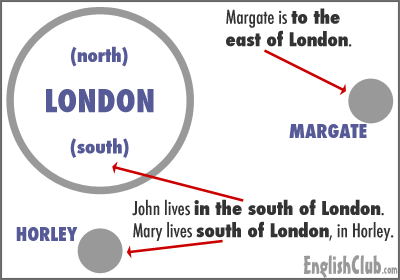
Here are some more examples:
- Paris is in the north of France.
- Sweden is north of France.
- Belgium is to the north of France.
- Canada is north of the USA.
- The USA is north of Mexico
- Mexico is south of the USA.
- Moscow is in the west of Russia.
- Europe is west of Russia.
- Europe is to the west of Russia.
- Shanghai is in the east of China.
- Japan is east of China.
- Japan is to the east of China.
domingo, 4 de noviembre de 2018
Questions on the short story THE HORRORS OF THE ROAD
: HORRORS
OF THE ROAD (by Fay Weldon)
Questions:
1- Who are the characters of the story?
2- Where does the story take place?
3- How long does the story take?
4- Who sent her to see a psychiatrist? Why?
5- What physical conditions is she in? Why?
6- Where is Piers while she’s with the psychiatrist?
7- Does she like being there?
8- What do doctors think about her illness?
9- What does Miss Jacobs say about her paralysis? When
did it start?
10- What does Piers do?
11- Does Miss
Jacobs have a profession? Does she work? Do you think the fact she has studied
and does not work has affected her somehow?
12- What kind of a driver is Piers?
13- Would you say Piers is a fussy man? Explain.
14- Does she really lover her husband as much as she says?
15- Does Piers love her?
16- Is Miss Jacobs a frustrated woman? Why? / Why not?
17- Is Pier guilty of her suffering? Why? / Why not?
18- Did you like
the story? Explain.
19- What do you think Miss Jacobs did after her visit to
the psychiatrist?
20- Did she ever return there?
lunes, 22 de octubre de 2018
Prefixes and suffixes
Prefixes and suffixes can help you understand a word. They give you important information about the word.
Some prefixes give adjectives the opposite meaning:
un- happy - unhappy
im- possible - impossible
dis- satisfied - dissatisfied
ir- regular - irregular
il- legal - illegal
Other prefixes make a word negative:
anti- social - antisocial
non- profit - non-profit
Suffixes can tell you what type of word it is, e.g. nouns often end in -ment (enjoyment), -ness(happiness) or -ion (education). Here are some common suffixes for nouns.
-ment - management / arrangement
-ism - racism / communism
-ness - happiness / sadness
-ship - friendship / relationship
-er/-or - director / teacher
-tion - communication / education
Common suffixes for verbs:
-ate - create / activate
-ify - verify / solidify
-ise/-ize - authorise / categorise
Common suffixes for adjectives:
-able - reliable / capable
-al - accidental / universal
-ful - helpful / wonderful
-ous/-ious - dangerous / nervous / religious
-ive - creative / sensitive
Suscribirse a:
Entradas (Atom)
-
The verbs think, believe, say, report, know, expect, consider, understand etc are used in the following passive patterns in personal and...
-
(Love Is Like A) Heat Wave Martha and the Vandellas Whenever I'm with you Something inside Starts to burn deep A...

