Click on this link and read more about reporting verbs. There are exercises, too!!!!
REPORTING VERBS
jueves, 5 de septiembre de 2019

viernes, 30 de agosto de 2019

Crime and Punishment
Click on this link and expand your vocabulary. You can also listen to the words
CRIME AND PUNISHMENT VOCABULARY

CRIME AND PUNISHMENT VOCABULARY


The Passive -
The verbs think, believe, say, report, know, expect, consider, understandetc are used in the following passive patterns in personal and impersonal constructions.
Active: People believe that he lied in court.
Passive: 1. It is believed (that) he lied in court. (impersonal)
It + passive + that-clause
2. He is believed to have lied in court. (personal)
Subject + passive + to-infinitive
Active: They expect him to arrive soon.
Passive: 3. It is expected (that) he will arrive soon. (impersonal)
It + passive + that-clause
4. He is expected to arrive soon. (personal)
Subject + passive + to-infinitive
lunes, 25 de marzo de 2019
domingo, 25 de noviembre de 2018

Articles -
North, South, East and West - Usage
Each of the points of the compass (north, south, east, west, south-east, north-west etc) can be:
- noun - The sun rises in the east.
- adjective - It is sunny on the east coast.
- adverb - We drove east for 50 miles.
Look at some more example sentences:
| Penguins live in the south. | noun |
| The wind is coming from the east. | |
| He lives in the south-east of England. | |
| He lives in South London. | adjective |
| The storm will reach the north-west coast tomorrow. | |
| Polar bears live at the North Pole. | |
| Penguins live at the South Pole. | |
| Is the country South Africa in the south of the African continent? | adjective | noun |
| Our house faces south-west. | adverb |
| Our car broke down a mile east of the city. | |
| He lives south of London. |
The points of the compass are capitalized when they form part of a name, for example: South Africa, East Timor, North America, the South Pole, Northwest Territories
In the picture below, notice the important difference between "in the south"and "to the south" or just "south":
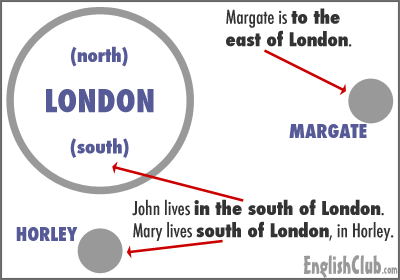
Here are some more examples:
- Paris is in the north of France.
- Sweden is north of France.
- Belgium is to the north of France.
- Canada is north of the USA.
- The USA is north of Mexico
- Mexico is south of the USA.
- Moscow is in the west of Russia.
- Europe is west of Russia.
- Europe is to the west of Russia.
- Shanghai is in the east of China.
- Japan is east of China.
- Japan is to the east of China.
domingo, 4 de noviembre de 2018
Questions on the short story THE HORRORS OF THE ROAD
: HORRORS
OF THE ROAD (by Fay Weldon)
Questions:
1- Who are the characters of the story?
2- Where does the story take place?
3- How long does the story take?
4- Who sent her to see a psychiatrist? Why?
5- What physical conditions is she in? Why?
6- Where is Piers while she’s with the psychiatrist?
7- Does she like being there?
8- What do doctors think about her illness?
9- What does Miss Jacobs say about her paralysis? When
did it start?
10- What does Piers do?
11- Does Miss
Jacobs have a profession? Does she work? Do you think the fact she has studied
and does not work has affected her somehow?
12- What kind of a driver is Piers?
13- Would you say Piers is a fussy man? Explain.
14- Does she really lover her husband as much as she says?
15- Does Piers love her?
16- Is Miss Jacobs a frustrated woman? Why? / Why not?
17- Is Pier guilty of her suffering? Why? / Why not?
18- Did you like
the story? Explain.
19- What do you think Miss Jacobs did after her visit to
the psychiatrist?
20- Did she ever return there?
lunes, 22 de octubre de 2018
Prefixes and suffixes
Prefixes and suffixes can help you understand a word. They give you important information about the word.
Some prefixes give adjectives the opposite meaning:
un- happy - unhappy
im- possible - impossible
dis- satisfied - dissatisfied
ir- regular - irregular
il- legal - illegal
Some prefixes give adjectives the opposite meaning:
un- happy - unhappy
im- possible - impossible
dis- satisfied - dissatisfied
ir- regular - irregular
il- legal - illegal
Other prefixes make a word negative:
anti- social - antisocial
non- profit - non-profit
anti- social - antisocial
non- profit - non-profit
Suffixes can tell you what type of word it is, e.g. nouns often end in -ment (enjoyment), -ness(happiness) or -ion (education). Here are some common suffixes for nouns.
-ment - management / arrangement
-ism - racism / communism
-ness - happiness / sadness
-ship - friendship / relationship
-er/-or - director / teacher
-tion - communication / education
Common suffixes for verbs:
-ate - create / activate
-ify - verify / solidify
-ise/-ize - authorise / categorise
-ment - management / arrangement
-ism - racism / communism
-ness - happiness / sadness
-ship - friendship / relationship
-er/-or - director / teacher
-tion - communication / education
Common suffixes for verbs:
-ate - create / activate
-ify - verify / solidify
-ise/-ize - authorise / categorise
Common suffixes for adjectives:
-able - reliable / capable
-al - accidental / universal
-ful - helpful / wonderful
-ous/-ious - dangerous / nervous / religious
-ive - creative / sensitive
-able - reliable / capable
-al - accidental / universal
-ful - helpful / wonderful
-ous/-ious - dangerous / nervous / religious
-ive - creative / sensitive
lunes, 30 de julio de 2018
Short Story The canterville Ghost
Canterville Ghost Question and answers by Oscar Wilde
Question Analysis
Prepared by Sumit Thakur (Faculty of Goodwill
Education)
Q1. When and where did Virginia meet the ghost for the
first time?
Ans. One day Virginia and her curly-haired lover went
out riding on the meadows. There, in getting through a hedge, she tore her
dress very badly. Back home, she went up by the back staircase so as not to be
seen. As she was running past a room, she saw someone inside the room. She
thought it was her mother’s maid, who sometimes brought her work there.
Virginia looked in to ask the maid to mend her dress. But she was surprised to
see that it was not the maid but the Canterville ghost himself. He was sitting
by the window and looking outside. His head was leaning on his hand. He seemed
to be extremely depressed. Virginia’s first idea was to run away and lock
herself in her room. But the sad expression on the ghost’s face filled her with
pity. She decided to go in and comfort the ghost. So light was her football,
and so deep was his melancholy, that he was not aware of her presence till she
spoke to him. “I am so sorry for you,” said Virginia. This was the place where
Virginia met the ghost for the first time.
Q2. What did the ghost want Virginia to do for him and
why?
Ans. The ghost sold Virginia the story of his sin. He
told her how he killed his wife and how nine years later his wife’s brothers
imprisoned him in a secret room and starved him to death. He was not given a
proper burial and no one had prayed for his soul. Having failed to win God’s
mercy, he had to exist in the form of a ghost and had been in that state for
three hundred years. He was now in a state in which he had no tears to weep for
his sins. He had no faith and could not pray for his soul. Therefore, he wanted
Virginia to do all this for him. Only then God would have mercy on him and let
him have the peace of Death. Says the ghost to Virginia. “You must weep with me
for my sins, because I have no tears. You must pray with me for my soul,
because I have no faith. Since you are sweet and good, the Angel of Death will
have mercy on me.” The ghost took the little girl where his skeleton had been
lying for three hundred years. There the little girl wept for him and prayed
for him.
Q3. Why did Mr. Otis conclude that Virginia had been
kidnapped by the gipsies?
Ans. The ghost had taken Virginia with him to his
secret room. A little later, the bell rang for the evening tea. As Virginia did
not come down, Mrs. Otis sent up one of the footmen to tell her. He returned
after a little time and said that he could not find Miss Virginia anywhere. As
she was in the habit of going out to the garden every evening to get flowers,
Mrs. Otis was not alarmed at first. But when the clock struck six and Virginia
did not appear. Mrs. Otis became really upset. She sent the boys out to look
for her. She herself and Mr. Otis searched every room in the house. At half
past six, the boys came back and said they could find no trace of Virginia
anywhere. They were all now in the greatest state of excitement. No one knew
what to do. Then Mr. Otis suddenly remembered that some days before, a band of
gipsies had camped near the house. He concluded that the girl had been
kidnapped by them. He at once set off for the place where he knew they would be
camping.
Q4. Where and when was Virginia found at last?
Ans. All attempts to find out Virginia had failed and
everyone was in a state of deep shock. There was dead silence in the house.
They had their supper, but it was a melancholy meal. Hardly anyone spoke a word
during the supper. When they had done that night, and that in the morning he
would ask Scotland Yard for some midnight hour. And when the last stroke
sounded, they heard a dreadful peal of thunder that shook the house. A wainscot
panel at the top of the staircase flew back with a loud noise. And out on the
landing stepped Virginia, looking very pale and white. She had a little box in
her hand. In a moment, all rushed up to her. Mrs. Otis clasped her passionately
in her arms. Everybody ran up to her. “Good heavens child, where have you
been?” said Mr. Otis. “Papa,” said Virginia quietly, “I have been with the
ghost.” Thus Virginia was found at last.
Q5. How was the mystery of the ghost solved in the
end?
Ans. Virginia had been with the ghost in his secret
place. There she wept for his sin and prayed for his soul. The Angel of Death
took pity on the ghost and gave him the peace of Death. When Virginia come
back, she told her family where she had been. She said, “Papa, he is dead and
you must come to see him. He was really sorry for all that he had done.” She
led them to a small low room. Fixed in the wall was a huge iron ring, and
chained to it was a skeleton. The skeleton was stretched out at full length on
the stone floor. It seemed to be trying to grasp with its long fleshless
fingers an old-fashioned plate and jug, that were placed just out of its reach.
The jug had evidently been once filled with water, as the inside of it was
covered with green mould. There was nothing on the plate but a pile of dust.
Thus the whole mystery of the terrible tragedy was revealed. Sir Simon (the
ghost) had first killed his wife and then his wife’s brothers had imprisoned
him in a secret cell and starved him to death.
Q6. Describe briefly the funeral of the Canterville
Ghost.
Ans. The funeral started from Canterville Chase at
about eleven o’clock at night. The hearse was drawn by eight black horses. The
coffin was covered with a rich purple pall. By the side of the hearse and the
coaches walked the servants with lighted torches. The whole procession was
wonderfully impressive. Lord Canterville was the chief mourner. He had come up
specially from Wales to attend the funeral. A deep grave had been dug in the
corner of the churchyard. The service was read in the most impressive manner.
When the service ceremony was over, the servants extinguished their torches.
Then the coffin was lowered into the grave. Virginia stepped forward, and laid
on it a large cross made of white and pink blossoms. As she did so, the moon
came out from behind a cloud, and the little churchyard became flooded with
silvery light. From a distant tree, a nightingale began to sing. Virginia’s
eyes became dim with tears. She hardly spoke a word during the drive home.
Q7. Give in brief a character-sketch of Mr. Hiram B.
Otis.
Ans. Mr. Otis is an American Minister who has come
with his family to live in London. He is proud of being an American. He calls
his country a modern country where one can have everything that money can buy.
He doesn’t believe in ghosts and says that if there were any such thing as a
ghost in Europe, they would take it to their own country and keep it there in a
museum. And when he actually sees a ghost in front of him, he is not at all
afraid. Rather he asks the ghost not to disturb him with the loud clank of his
chains. He even gives the ghost a bottle of lubricator to oil his chains.
Another noteworthy point of Mr. Otis’s character is his deep love for his
daughter and his true concern for all others in the family. He is deeply upset
when Virginia is ‘lost’, but at the same time orders others to sit down for
dinner. He himself goes out even without his dinner to look for his daughter.
And his rare sense of honesty comes to light when he insists upon lord
Canterville to take back the jewels that the ghost has given to Virginia. He
thinks they are the property of Lord Canterville’s family and as such must go back
to them. Mr. Otis is indeed a lovable character.
Q8. Give in brief a character-sketch of Mrs. Otis.
Ans. Mrs. Otis was a handsome middle-aged woman. She
had a superb profile and a magnificent constitution. She loved life and, in
many, respects was quite English. Before her marriage she was known as Miss
Lucretia R. Tappan. She was a celebrated New York belle. Like her husband she,
too, has no belief in ghosts. She shows no nervousness at all when the
housekeeper, Mrs Umney, tells her that blood has been spilt on the library
floor. Instead of getting anxious about whose blood it is or why it has been
spilt there, she merely says, “I don’t all care for blood-stains in a
sitting-room. It must be removed at once,” And when the blood-stain appears
again and again after it is removed every time, she accepts with other members
of the family that a ghost does live in the house. But she doesn’t feel upset
in the least. Rather when she hears the cries of the ghost, she offers him
medicine thinking that he is ill. On the whole, Mrs. Otis gives the impression
of a beautiful woman with no real depth of mind.
Q9. Give in brief a character-sketch of Washington.
Ans. Washington is the eldest son of the Otis family.
He was given this name by his parents in a moment of patriotism. He was a
good-looking young man who had qualified himself for American diplomacy. In his
own country as well as in London, he was well-known as an excellent dancer.
Like his parents, he, too, didn’t believe in ghosts. When Mrs. Umney related
the story behind the blood-stain, he said, “That is all nonsense.” He at once
took out a stain remover and rubbed it on the blood-stain. In a few moments, no
trace of the blood-stain could be seen on the floor. But when the blood-stain
reappeared every time after it was removed, Washington and others of his family
had to admit the existence of the ghost. The ghost on his part bore a deep
grudge against Washington for removing the blood-stain every time he made it.
Washington, on the whole, is an amusing character in the story.
Q10. What idea of Virginia’s character do you form
from your study of The Canterville Ghosts?
Ans. Miss. Virginia E. Otis was a girl of fifteen. She
was as lively and lovely as a fawn. She once outraced a certain Lord Bilton on
her pony. The young Duke of Cheshire was so delighted that he at once proposed
to her. Virginia proves to be the best character in the story. She is the only
one in her family who doesn’t mock at the ghost. She does nothing to annoy the
ghost who, she knows, is the restless spirit of Sir Simon de Canterville. She
believes the story told by the housekeeper, Mrs Umney. She hates Sir Simon for
killing his wife, yet she prays to the Angel of Death to have mercy on him and
give him the peace of Death. It is only because of her that the ghost gets a
proper burial and can now have the peace of Death in his grave. We have to
agree with the young Duke when he says, “What an angel you are”.
Q11. What idea do you form of the Otis twins from your
study of ‘The Canterville Ghost’.
Ans. The Otis twins are the most lively and carefree
characters in the story. They are usually called the Star and Stripes as they
are always getting swished. They are true republicans. They never lose any
opportunity to tease the poor ghost. They throw on him a jug of water, shout a
loud ‘BOO’ in his ears, shoot peas at him, frighten him by making a white
curtain look like a ghost, and stretch strings across the corridor over which
he trips in the dark. Fed up with these mischiefs of the twins, the ghost at
last decides to teach them a lesson. But even his plan of revenge rebounds on
him when he appears before them in the character of the Headless Earl. But we
can excuse the twins for all their acts of mischief because what is left of a
child if there were no fun or naughtiness in them. We must not forget that it
is only one of the twins who draws the attention of the family to the
blossoming of the withered almond-tree in the churchyard. The blossoming of the
withered tree symbolises what Virginia says : “God has forgiven him.”
Q12. Give a brief character-sketch of the Duke of
Cheshire.
Ans. The Duke of Cheshire is a romantic youth who is
deeply in love with Virginia. He sees her once riding a pony and outracing a
certain Lord Bilton. He is so overcome by her beauty that he proposes to her on
the spot. He was then just a school-going boy. His parents are so shocked at
his premature amorousness that, in floods of tears, they send him back to Eton.
However, the Duke’s love for Virginia is really very deep and true. When
Virginia is thought to have been lost, he refuses to have any dinner as long as
Virginia is ‘lost’. When after their marriage, Virginia refuses to share with
him the secret of her meeting the ghost, he doesn’t get angry at all. Rather he
says, “You can have your secret as long as I have your heart.” To this Virginia
says, “You have always had that, Cecil.” Surely such a loving pair deserves the
choicest of God’s blessings.
Q13. What idea do you form of Lord Canterville’s
character from your study of ‘The Canterville Ghost’?
Ans. Lord Canterville is the present owner of the
Canterville Chase. He wants to dispose it of since it is a haunted place. But
he is a very fair and honest person. He doesn’t want to keep the prospective
buyer in any doubt about it. When Mr. Otis comes to discuss the terms with him,
he tells him very plainly, “We have not cared to live in the place ourselves,”
He also relates specific incidents to show how the previous occupants of the
house were frightened by the ghost on different occasions. He also says that
the ghost makes its appearance before the death of any member of the family.
“So does the family doctor,” says Mr. Otis mockingly,
since he doesn’t believe in ghosts. Whether ghosts exist or not, that is a
debatable question, but there can be no debate on Lord Canterville’s honesty
and integrity. This becomes all the more evident at the end of the story when
he refuses to have the jewels that the Canterville ghost has given to Virginia.
He says to Mr. Otis, “My dear sir, your charming little daughter rendered my
unlucky ancestor, Sir Simon, very important service and I and my family are
much indebted to her. The jewels are clearly hers.” To conclude, we can say
that next to Virginia, Lord Canterville is the most praiseworthy character in
the story.
sábado, 30 de junio de 2018
File 7 A Confusing verbs 2
CONFUSING VERBS
argue verb (DISAGREE)
[ I ] to speak angrily
to someone, telling that person that you disagree with them:
·
It's normal for couples to argue now and then.
·
When two of your best friends argue it puts you in a
very awkward position.
·
They used to argue all the time and now they've
practically stopped talking to each other.
·
My mother never takes sides when my brother and I
argue.
·
Stop arguing with me, Daryl, and do as you're told!
Discuss verb /dɪˈskʌs/
to talk
about something to other people, often exchanging ideas or opinions:
·
We have been discussing the possibility of working
together.
·
This booklet discusses how to invest money wisely.
Notice verb UK /ˈnəʊ.tɪs/ US /ˈnoʊ.t̬ɪs/
to see
or become conscious of something or someone:
·
I noticed a crack in the ceiling.
·
Mary waved at the man but he didn't seem to notice.
·
[ + (that) ] He noticed (that) the woman was staring
at him.
·
[ + question word ] Did you notice how she did that?
Realize verb uk usually realise UK /ˈrɪə.laɪz/
US /ˈriː.ə.laɪz/
realize verb (BECOME
AWARE)
to understand
a situation, sometimes suddenly:
·
They
didn't realize the danger they were in.
·
"Do
you realize (that) this is the third time you've forgotten?" she said
angrily.
·
I
realize how difficult it's going to be, but we must try.
·
As
he watched the TV show, he suddenly realized (that) he'd seen it before.
·
"You're
standing on my foot." "Sorry, I didn't realize."
Avoid verb [ T ] UK /əˈvɔɪd/ US
/əˈvɔɪd/
to stay away from someone or something:
·
I
try to avoid supermarkets on Saturdays - they're always so busy.
·
I'm
anxious to avoid the motorway at rush hour.
·
Do
you think Lukas is avoiding me? I haven't seen him all day.
Prevent verb [ T ] UK
/prɪˈvent/ US /prɪˈvent/
to stop
something from happening or someone from doing something:
·
Label
your suitcases to prevent confusion.
·
[ +
-ing verb ] His disability prevents him (from) driving.
·
The
police seem to be powerless to prevent these attacks.
·
She
would go over the accident again and again in her mind, wishing that she could
somehow have prevented it.
·
A
block in the pipe was preventing the water from coming through.
·
Fierce
winds prevented the race from taking place.
Look verb UK /lʊk/ US /lʊk/
look verb (SEE)
to direct your eyes
in order to see:
·
Look!
There's grandma.
·
They
looked at the picture and laughed.
·
Look
at all these toys on the floor.
·
She
looked up from her book and smiled at me.
Seem verb [ I + adv/prep, L ] UK
/siːm/ US /siːm/
to give the effect of being;
to be judged to be:
·
He's
16, but he often seems (to be) younger.
·
The
children seemed (as if/as though/like they were) tired.
·
I
suspect his claims are not all they seem - he tends to exaggerate.
·
They
seem to be taking a long time to decide.
·
It
seems (that) she can't come.
Mind
don’t mind, he
doesn’t mind
We can use
don’t/doesn’t mind to mean ‘not feel annoyed or worried by
something’.
·
I
don’t mind living near the train line. You get used to it.
·
She
doesn’t mind waiting up late.
Warning:
We say I don’t mind,
or it doesn’t matter. We don’t say it doesn’t mind:
A: Sorry, there are no more chairs!
B: I
don’t mind. I can sit on the floor. (or It doesn’t matter. I can sit on the
floor.)
Not: It doesn’t mind
…
Matter as a verb
Matter in the
negative
The most common use
of the verb matter is in the expression it doesn’t matter (and the less common
forms it didn’t matter, it wouldn’t matter and it won’t matter). It doesn’t
matter means ‘it is not important’, ‘I don’t mind’ or ‘it is not a problem’:
A:I forgot to buy milk when I was in town.
B:It
doesn’t matter. We’ve got enough till tomorrow.
·
It
doesn’t matter if you can’t be here by nine o’clock. We can start without you
and you can join us later.
·
It
wouldn’t matter if we didn’t invite Paul and Jan to the wedding. They wouldn’t
expect to be invited.

Suscribirse a:
Entradas (Atom)
-
The verbs think, believe, say, report, know, expect, consider, understand etc are used in the following passive patterns in personal and...
-
(Love Is Like A) Heat Wave Martha and the Vandellas Whenever I'm with you Something inside Starts to burn deep A...

